| The Hatmaker's Sign A Story by Benjamin Franklin Retold by Candace Fleming Illustrated by Robert Andrew Parker
The Hatmaker's Sign is a story that Benjamin Franklin told to Thomas Jefferson to make him feel better about the changes people wanted to make to the Declaration of Independence. Thomas Jefferson thought it was perfect but some members of Congress wanted to rewrite it and leave parts out. Benjamin Franklin tells him the story of the hatmaker's sign.
A hatmaker is getting ready to open up his own shop and he has designed the sign he wants to hang above his door. He thinks it is perfect but his wife suggests that he leave out a part of the sign. He agrees and decides to remake the sign, he then heads off towards the signmakers shop when he comes across someone who tells him he should leave a part out of it. He agrees and designs a new sign. This keeps happening over and over until finally the sign is blank. When he takes the blank sign to the signmaker, the signmaker is confused. The hatmaker tells him what happened and then the signmaker suggests a design for the sign. It is the exact same design the hatmaker originally made, he thinks it is perfect.
Benjamin Franklin tells Thomas Jefferson that no matter how well something is written people will want to change it. Thomas Jefferson struggles with this as the Congress debates his Declaration, but in the end they did not change it much, they thought it was perfect.
This is a great story to read to 2nd graders up to 4th grade. This book would be good to illustrate to children that even though they might have to revise a paper it is okay. I think it also a good lesson that you should trust your instincts and that not everyone will agree with everything you do.
|
Wednesday, April 24, 2013

Thursday, April 18, 2013
 Sweet Clara and the Freedom Quilt by Deborah Hopkinson paintings by James Ransome
This is a story about an 11 year old black girl named Clara who is a slave. She gets separated from her mother and has to go work in the field. She gets very sad and people start to worry about her health because she has to work hard. A nice lady she calls her Aunt Rachel decides to teach Clara how to quilt so she can get out of the fields and be a seamstress in the house. Clara passes the test and gets to work inside. Once she is inside she learns what a map is and about the underground railroad. She wants to make a map so she decides to make a map on a quilt. By using her knowledge she gained from others she makes the map and then leaves it behind for others when she escapes and finds her Mother and new sister. She hears stories about people who have escaped to the North by studying her quilt.
This would be a great book to read to a 1st to 4th grade class. I really enjoyed it. It has a good lesson that if you stick to your goals you can eventually succeed. It would also be good to talk about slavery and how people used the underground railroad to escape. I think a good classroom activity would be to make a quilt map out of construction paper.
Thursday, April 11, 2013
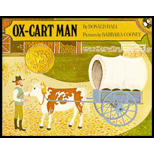 |
| Ox-Cart Man by Donald Hall Pictures by Barbara Cooney |
Ox cart man is set in colonial times in America. The man takes an ox-cart to town to sell all of the extra food and items that he and his family had left over at the end of the year. They load the ox-cart up with all kinds of household goods like linen and candles they had made. They also load up a lot of food. With his cart full he starts the long journey into town to sell his goods. When he gets there he sells everything he has, even the ox and the cart. He bought presents for the whole family including a big sack of candy. After he bought all he needed he starts the long journey home. He gives the kids and his wife their gifts, which they quickly start making things to sell for next year. The whole process starts once again.
I enjoyed reading this book. It has a nice rhyming scheme that young kids will enjoy. The pictures are nice and it is a calm story. This book would be good to read to children who are studying America during this time period. It might be a good idea to talk to kids about some of the vocabulary they might be familiar with. There is a moral in this story about how hard work pays off.
I would recommend this book to 2nd through 4th grade. This book was awarded the 1980 Caldecott Medal.
Thursday, April 4, 2013
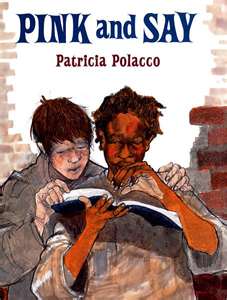 Pink and Say by Patricia Polacco
Pink and Say is a wonderful book about a friendship that is formed between two teenage boys during the Civil War. Say is shot in the leg and near death when Pink finds him. Pink carries him for a long way to where his mother Moe Moe Bay lives. Moe Moe nurses him back to health. While he is recovering he and Pink become good friends. Say is scared to go back to war and does not want to go. Just before they getting ready to leave a group of marauders comes and Moe Moe forces the boys into the cellar. She stays above to give them a sign when it is clear. When no sign comes they go upstairs to find Moe Moe shot dead. Then they are captured by Confederate soldiers and taken to a prison. Say is held for a few months but Pink is killed.
This would be a good book to read to a class studying the civil war. There are many activities online for student to do before or after reading this book. Before reading you can ask children to tell you what they think the story will be about. After reading you can discuss some of the complex vocabulary in the book that might be above their grade level. Because of the subject matter and the vocabulary I would recommend reading this to grades 2nd and above.
Here are a few websites that have activities for children to do.
Thursday, March 7, 2013
William's House
 |
| William's House by Ginger Howard Illustrated by Larry Day
William's House takes place in New England in 1637. William has immigrated from England and is going to build a house for his family. He decides he wants it to be just like his father's house in England. William is happy with the house he built. But after awhile he had to slowly start making changes to his house because the weather is so much different in New England than where his dad lives. Eventually he has made so many changes it does not look like his fathers house any more. When his cousin comes to visit him he asks "What kind of house is this?" and William tells him "This is our new home. Welcome!".
I enjoyed this book. I would recommend reading it 2nd grade to 3rd grade classrooms. I would classify it as historical fiction. It has a good lesson that even though things might not be the same as they were back home they can still be good. You can make your home wherever you choose. It also shows that change can be a good thing.
There are vocabulary words in this book that most kids would not be familiar with. It would be good to make a list of the potential foreign words and have explanations. This would be a good book to read if you are studying about American history around the 1600's.
|
Thursday, February 28, 2013
Barefoot (Escape on the Underground Railroad
 |
| Barefoot Escape on the Underground Railroad by Pamela Duncan Edwards
Barefoot is a slave that decides to escape one night. He is scared of the journey that lies ahead of him but he knows that whatever happens it has to be better than the life he is leaving behind. While Barefoot is making his way through the night he hears a heron let out a warning cry to the other animals. Barefoot is nervous that the animals might alert his pursuers to his presence. Instead the animals help him on his journey. When Barefoot reaches a house he is nervous because he can not see it well at night. Some fireflies help him by lighting up the night around the house so Barefoot can determine if the house is part of the underground railroad.
This book is an exciting piece of historical fiction and I would recommend it for 2nd grade and up. The author has wrote numerous children's books including a book about Rosa Parks and her bus ride that was very important in the civil rights movement. She also wrote books about animals that children might enjoy. I would recommend this book to any teacher that wants to talk about slavery and civil rights.
If a class was really interested in this book a teacher can contact the author and ask for a visit. She has done hundreds of presentations. Her website is filled with activities that children can do. Here is a link to her website: http://www.pameladuncanedwards.com/children.html
|
Wednesday, February 20, 2013
Peppe The Lamplighter
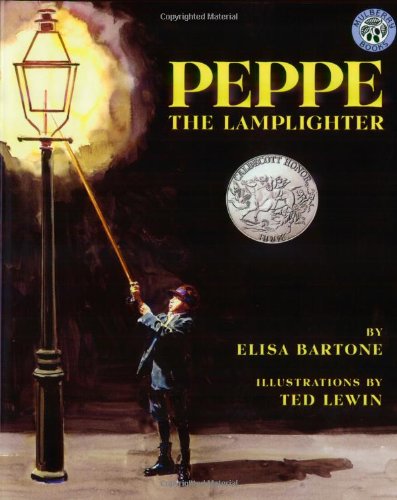 Peppe The Lamplighter by Elisa Bartone
Illustrated by Ted Lewin
Peppe lives in Little Italy before they had electric streetlights. He lives with 7 of his 8 sisters and his father, his mother passed away. Peppe tries to find work to help support his large family but can't find anyone that needs help. Finally, Domenico the lamplighter asks Peppe if he will be the lamplighter for him when he goes back to Italy. Peppe runs home excited to tell his family. His sisters congratulate him but his father is upset because he thinks that his son is too good for the lamplighter job.
As Peppe begins lighting the lamps he is excited and pretends that he is lighting candles at church. With each lamp he lights he says a prayer for someone he loves. After his father says he is ashamed of him Peppe becomes embarrassed to be a lamplighter. One day he decides not to light the lamps anymore. That night his little sister does not come home.
His father is worried about Peppe's little sister and he asks Peppe to go light the lamps because Assunta is afraid of the dark and that might be the reason she has not come home. His father tells him that the lamplighter job is important. Peppe is happy his father is proud of him and goes to light the lamps. With each lamp he lights he says a prayer for Assunta to be safe. At the last lamp he finds her curled up because she was afraid of the dark. Assunta tells Peppe that she wants to be just like him when she grows up because he scares away the dark. When he returns home with Assunta everyone runs to hug him even his father. His father tells Peppe he is proud of him.
The illustrations in this book do a good job of representing the atmosphere of the story. It is a good moral lesson about how you should not be ashamed of your job and that every job is important. This story also shows why it is important not to criticize people and their job. You never know when you might need their help.
This book might be good to read to children because some of them could be embarrassed by what their parents do for a living. Some kids might be embarrassed if their parent is a trash man or a sewage worker, but those jobs are very important to help society run efficiently.
Subscribe to:
Comments (Atom)