 |
| William's House by Ginger Howard Illustrated by Larry Day
William's House takes place in New England in 1637. William has immigrated from England and is going to build a house for his family. He decides he wants it to be just like his father's house in England. William is happy with the house he built. But after awhile he had to slowly start making changes to his house because the weather is so much different in New England than where his dad lives. Eventually he has made so many changes it does not look like his fathers house any more. When his cousin comes to visit him he asks "What kind of house is this?" and William tells him "This is our new home. Welcome!".
I enjoyed this book. I would recommend reading it 2nd grade to 3rd grade classrooms. I would classify it as historical fiction. It has a good lesson that even though things might not be the same as they were back home they can still be good. You can make your home wherever you choose. It also shows that change can be a good thing.
There are vocabulary words in this book that most kids would not be familiar with. It would be good to make a list of the potential foreign words and have explanations. This would be a good book to read if you are studying about American history around the 1600's.
|
Thursday, March 7, 2013
William's House

Thursday, February 28, 2013
Barefoot (Escape on the Underground Railroad
 |
| Barefoot Escape on the Underground Railroad by Pamela Duncan Edwards
Barefoot is a slave that decides to escape one night. He is scared of the journey that lies ahead of him but he knows that whatever happens it has to be better than the life he is leaving behind. While Barefoot is making his way through the night he hears a heron let out a warning cry to the other animals. Barefoot is nervous that the animals might alert his pursuers to his presence. Instead the animals help him on his journey. When Barefoot reaches a house he is nervous because he can not see it well at night. Some fireflies help him by lighting up the night around the house so Barefoot can determine if the house is part of the underground railroad.
This book is an exciting piece of historical fiction and I would recommend it for 2nd grade and up. The author has wrote numerous children's books including a book about Rosa Parks and her bus ride that was very important in the civil rights movement. She also wrote books about animals that children might enjoy. I would recommend this book to any teacher that wants to talk about slavery and civil rights.
If a class was really interested in this book a teacher can contact the author and ask for a visit. She has done hundreds of presentations. Her website is filled with activities that children can do. Here is a link to her website: http://www.pameladuncanedwards.com/children.html
|
Wednesday, February 20, 2013
Peppe The Lamplighter
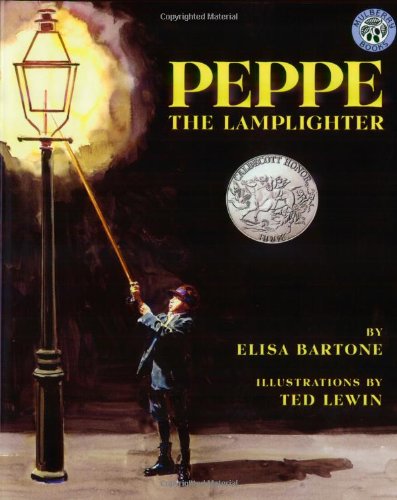 Peppe The Lamplighter by Elisa Bartone
Illustrated by Ted Lewin
Peppe lives in Little Italy before they had electric streetlights. He lives with 7 of his 8 sisters and his father, his mother passed away. Peppe tries to find work to help support his large family but can't find anyone that needs help. Finally, Domenico the lamplighter asks Peppe if he will be the lamplighter for him when he goes back to Italy. Peppe runs home excited to tell his family. His sisters congratulate him but his father is upset because he thinks that his son is too good for the lamplighter job.
As Peppe begins lighting the lamps he is excited and pretends that he is lighting candles at church. With each lamp he lights he says a prayer for someone he loves. After his father says he is ashamed of him Peppe becomes embarrassed to be a lamplighter. One day he decides not to light the lamps anymore. That night his little sister does not come home.
His father is worried about Peppe's little sister and he asks Peppe to go light the lamps because Assunta is afraid of the dark and that might be the reason she has not come home. His father tells him that the lamplighter job is important. Peppe is happy his father is proud of him and goes to light the lamps. With each lamp he lights he says a prayer for Assunta to be safe. At the last lamp he finds her curled up because she was afraid of the dark. Assunta tells Peppe that she wants to be just like him when she grows up because he scares away the dark. When he returns home with Assunta everyone runs to hug him even his father. His father tells Peppe he is proud of him.
The illustrations in this book do a good job of representing the atmosphere of the story. It is a good moral lesson about how you should not be ashamed of your job and that every job is important. This story also shows why it is important not to criticize people and their job. You never know when you might need their help.
This book might be good to read to children because some of them could be embarrassed by what their parents do for a living. Some kids might be embarrassed if their parent is a trash man or a sewage worker, but those jobs are very important to help society run efficiently.
Thursday, February 7, 2013
Tut Tut
 Tut, Tut by Jon Scieszka illustrated by Lane Smith
Tut, Tut is a great book for children in grades 3 through 5. It is part of a series of books featuring the time warp trio. The time warp trio is 3 young boys Joe, Sam, and Fred who get into crazy adventures from opening The Book that sends them on a time warp.
In Tut, Tut the time warp trio are working on dioramas of ancient Egypt when they are bothered by Joe's little sister, Anna. Anna and the trio get into an argument over whether or not there were queen Pharaohs. Anna makes a bet that there were queen Pharaohs and if she is right she gets her brothers weekly allowance and he has to clean the cat litter box.
Anna and the trio are warped through time to ancient Egypt. The trio is separated from Anna and find themselves in a treasure room. They are discovered by Hatsnat who does not like them and tries to execute them. They use their brains to get out of a couple situations. They tell Hatsnat that they are magicians so they will be taken to see the Hatshepsut, the Queen. After doing a magic trick for Hatshepsut they are reunited with Anna and have to escape from Hatsnat once more.
After finding the book they are able to time warp back to their home. Anna collects her money and the trio are left wondering what crazy adventure The Book will take them on next.
I thought this was a fun book to read. It would be good to read if the class is studying ancient Egypt. It also is a fun way to introduce basic concepts of physics because Joe uses common knowledge to make the Egyptians think he is a magician. He uses his knowledge of the center of gravity to have Anna bend over and lift a chair knowing that she will be able to since she is a girl. Then he has a big strong man try to lift it the same way and he is unable to. I might look into some of the other Time Warp Trio books because they might be useful in history lessons.
Tuesday, January 29, 2013
Baseball saved us
Baseball Saved Us is written by Ken Mochizuki and is illustrated by Dom Lee.
Baseball Saved Us is a story about a boy who was forced to go to an internment camp with his family during WWII. A young boy is sent to an internment camp during WWII because he and his family are Japanese-American. Many families are held here during the war because the government did not trust that they would be loyal to the United States. Life was turned upside down for these families, they could not work or do any of the activities they were use to. One young boy's father decides to make a baseball diamond in the camp so his son and others could regain some sort of normalcy. The boy is not very popular before he goes to the camp and is not very good at baseball. He is never given a chance since he is shorter than most boys his age. While in the camp he is among boys that are mostly the same size. They let him play ball, and he surprises them when he hits a homerun. After the people were let out of the internment camps the young boy has more confidence in his ball playing skills. Blocking out the racist chants he hit another homerun and proved himself to his peers on the outside.
This book is a good way to show how people were discriminated against during the World Wars. It shows that people strive for normalcy in adverse situations. Setting up a baseball field and playing the game probably made life bearable for the people who were confined unjustly. This book also illustrates that a whole community can rally together and help each other.
Baseball Saved Us is a story about a boy who was forced to go to an internment camp with his family during WWII. A young boy is sent to an internment camp during WWII because he and his family are Japanese-American. Many families are held here during the war because the government did not trust that they would be loyal to the United States. Life was turned upside down for these families, they could not work or do any of the activities they were use to. One young boy's father decides to make a baseball diamond in the camp so his son and others could regain some sort of normalcy. The boy is not very popular before he goes to the camp and is not very good at baseball. He is never given a chance since he is shorter than most boys his age. While in the camp he is among boys that are mostly the same size. They let him play ball, and he surprises them when he hits a homerun. After the people were let out of the internment camps the young boy has more confidence in his ball playing skills. Blocking out the racist chants he hit another homerun and proved himself to his peers on the outside.
This book is a good way to show how people were discriminated against during the World Wars. It shows that people strive for normalcy in adverse situations. Setting up a baseball field and playing the game probably made life bearable for the people who were confined unjustly. This book also illustrates that a whole community can rally together and help each other.
Subscribe to:
Posts (Atom)